Inter-Departmental Seminar BSc (Ag)
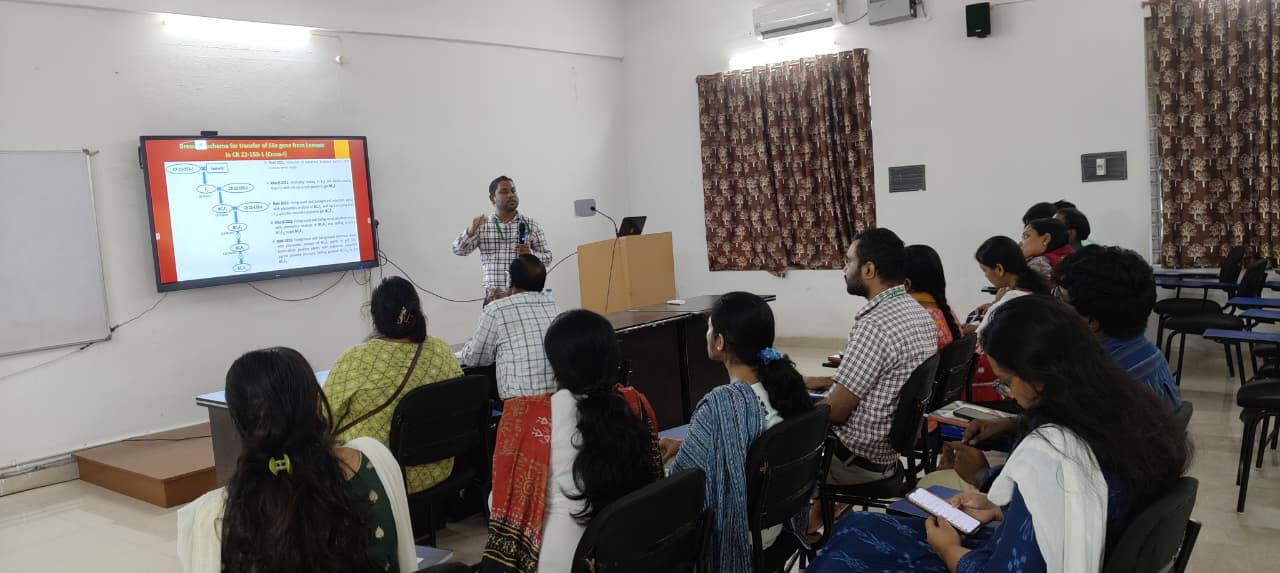
The seminar commenced with an introductory address and a warm welcome to the participants by Dr. Anmol Panda, Assistant Professor, Department of Agricultural Extension and Communication. Following this, Mr. Kalpataru Nanda, Assistant Professor, Department of Genetics and Plant Breeding, was invited to deliver his presentation on the topic “Marker-Assisted Introgression of Wide Compatibility Trait in Inter-Subspecific Rice Parental Line.”
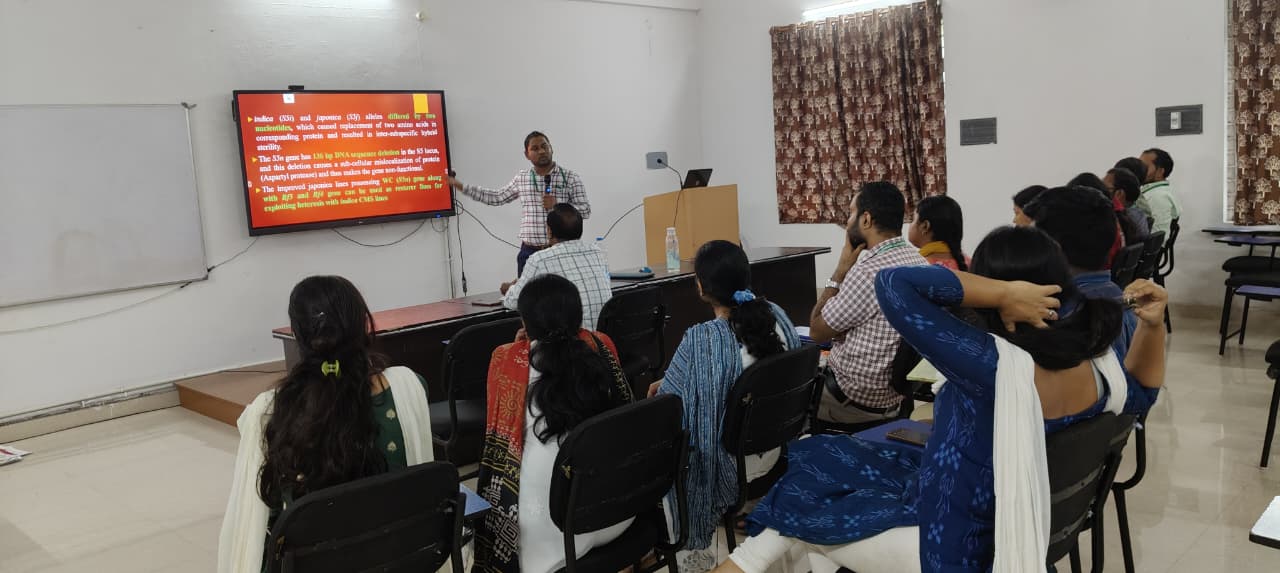
In his talk, the speaker highlighted that most of the existing rice hybrids are intraspecific indica × indica types, which have now reached a yield plateau, necessitating the diversification of hybrid rice parental lines. He emphasized that indica × tropical japonica hybrids offer the potential for the highest level of yield heterosis; however, their utilization is constrained by post-zygotic hybrid sterility barriers. The presentation focused on the marker-assisted introgression of the wide compatibility (WC) gene to overcome this sterility and promote hybrid fertility in indica × japonica hybrids. Mr. Nanda elaborated on the methodology of marker-assisted backcross breeding, which involves three critical steps:
1. Foreground selection to identify the target trait,
2. Background selection to ensure maximum genome recovery of the recurrent parent, and
3. Recombinant selection to transfer the target gene without undesirable linked segments from the donor parent.
The study identified 23 genotypes carrying the wide compatibility gene (S5n) and 8 genotypes possessing all three key genes—S5n, Rf3, and Rf4. The recurrent parent was successfully introgressed with the S5n gene, achieving over 90% recovery of the recurrent parent genome through background selection. Notably, the improved restorer line, when crossed with indica CMS lines, produced hybrids exhibiting more than 80% spikelet fertility, clearly demonstrating the role of the S5n gene in restoring hybrid fertility in indica × japonica crosses.
The presentation was highly informative and provided valuable insights into the application of molecular breeding tools for trait introgression. It was well appreciated by the faculty members and students. The session concluded with an engaging question-and-answer interaction, followed by a formal vote of thanks delivered by Dr. Anmol Panda.