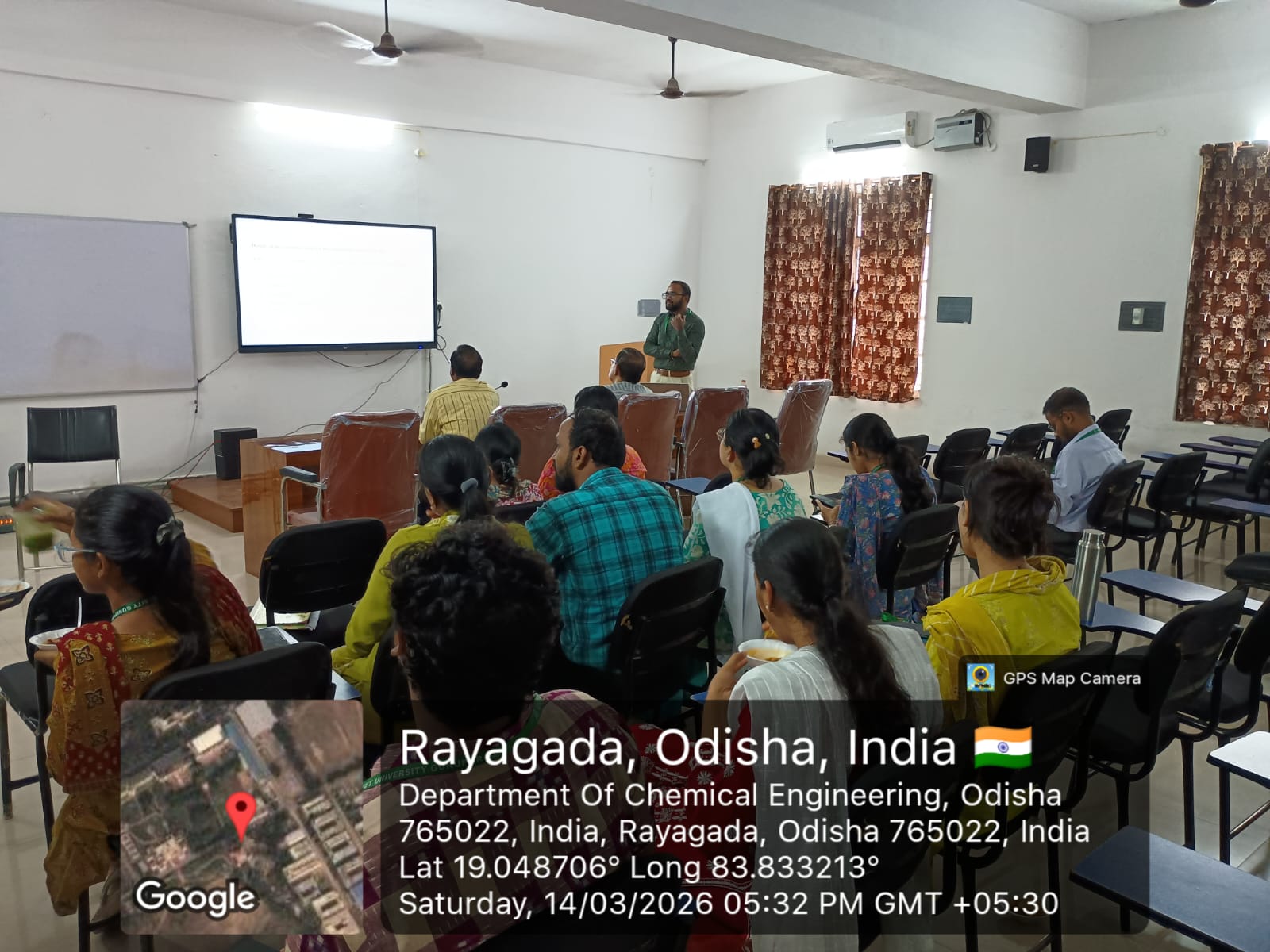
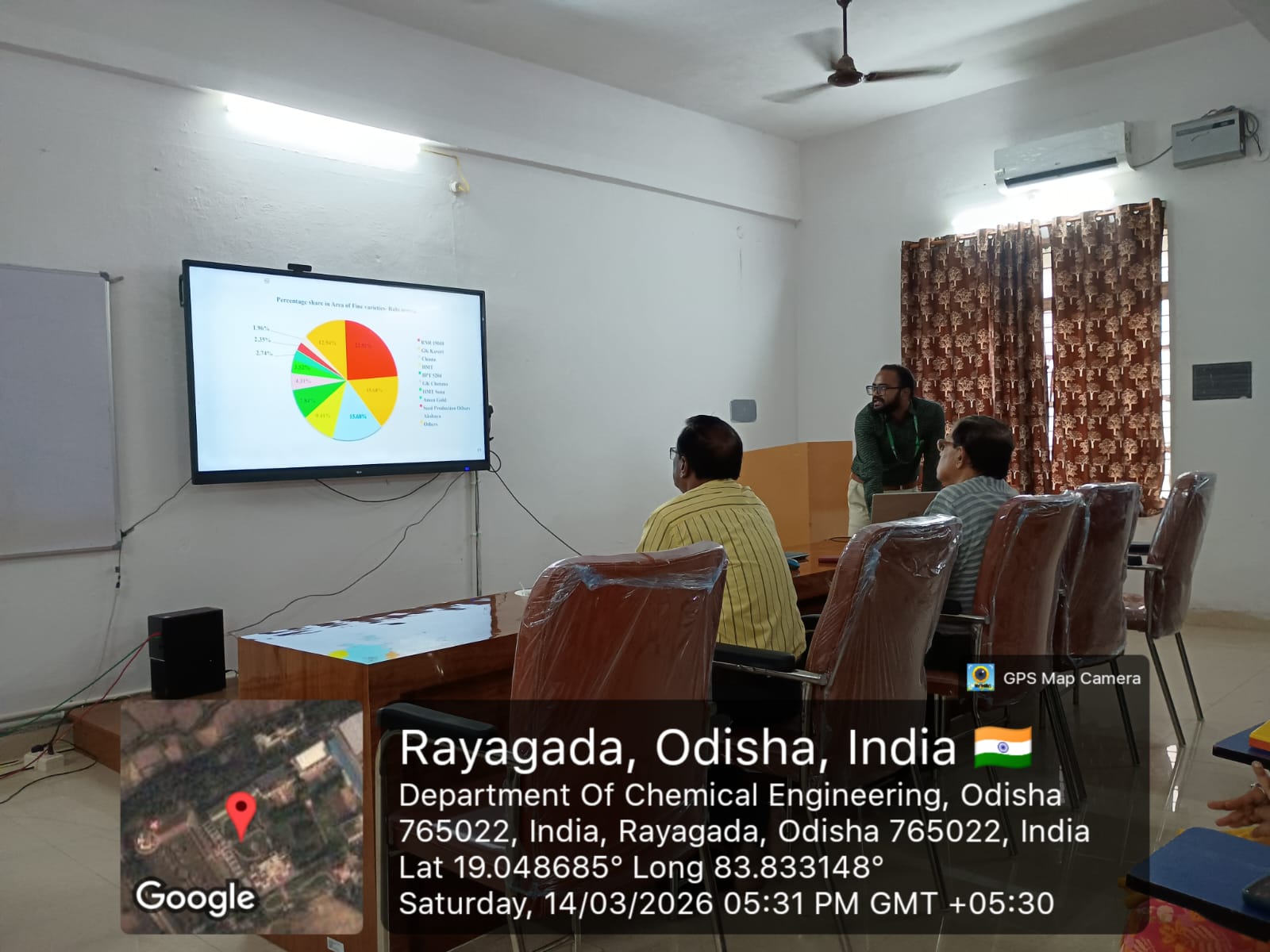
Inter-Departmental Seminar
At the outset of the seminar session, Dr. Kalpataru Nanda, Assistant Professor, Department of Genetics and Plant Breeding, weleoned the faculty members and participants. He then invited Mr. S. Satish, Assistant Professor, Department of Agricultural Economics, School of Agriculture. GlET University, Gunupur, to deliver his seminar presentation on the topic “Farmers’ Preferences for Rice Varictal Traits and Impact of Improved Rice Varieties.” The speaker began by highlighting the importance of agriculture in India’s economy and the crucial role of rice as a staple crop. He presented an overview of paddy production in lndia, noting that the country cultivates rice on about 47.8 million hectares with a production of around 137.82 million tonnes and an average productivity of 2882 kg per hectare. The adoption of high yielding varieties, expansion of irrigation, and the development of dwarf varieties were identified as major factors contributing to increased rice production. However, he emphasized that despite the development of many improved varieties, their adoption often remains uneven
due to differences in farmers’ varietal trait preferences and local agro-climatic conditions. Mr. Satish explained the analytical methods used in the study, including decomposition analysis and the Cobb-Douglas production function, which help to identify the contribution of inputs and technological changes to output growth. The concept of neutral and non-neutral technological change and the Response Priority Index (RPI) method were also discussed as a tool for assessing farmers’ preferences for different varietal traits. The seminar further presented the scenario of paddy production in Telangana, where the area under rice cultivation and production increased significantly due to irrigation expansion and government procurement policies. The study revealed that adoption of coarse rice varieties resulted in higher yield and income compared to fine varieties. The presentation concluded with policy implications emphasizing efficient input use, improved mechanization, strengthened extension services, and the development of rice varieties incorporating farmer-preferred traits. Overall, the seminar was informative and well appreciated by the audience. An interactive discussion followed, after which Dr. Kalpataru Nanda proposed the vote of thanks and the seminar concluded successfully.
Read More