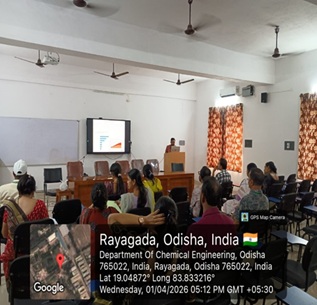
Inter-Departmental Seminar
Inter-Departmental Seminar Report for 01.04.26
At the outset of the seminar session, Dr. Kalpataru Nanda, Assistant Professor, Department of Genetics and Plant Breeding, welcomed the faculty members and participants. He then invited Dr. Tushar Ghosh, Assistant Professor (Horticulture), School of Agriculture, GIET University, Gunupur, to deliver his seminar presentation on the topic “Eco-Friendly and Cutting-Edge Innovations in Urban Landscaping.”
The speaker began by highlighting the challenges posed by rapid urbanization, including environmental degradation, biodiversity loss, urban heat island effects, and water scarcity. He defined urban landscaping as the scientific integration of green spaces within urban environments, combining horticulture, ecology, and urban planning to create sustainable and functional ecosystems. The importance of modern landscaping in addressing climate change and improving urban resilience was emphasized. He then elaborated on key components of urban landscaping such as parks, vertical greenery systems, streetscapes, and residential gardens. He discussed emerging trends including green-blue infrastructure, smart landscaping, xeriscaping, and the use of biodesign materials. The concept of green-blue infrastructure, incorporating rain gardens, bioswales, wetlands, and permeable pavements, was explained in detail for its role in stormwater management, groundwater recharge, and pollution control.
The seminar further covered the integration of advanced technologies such as Artificial Intelligence (AI), Internet of Things (IoT), sensors, and drones in landscape management. These technologies enable efficient irrigation, real-time monitoring of environmental parameters, and data-driven decision-making. The concept of xeriscaping using drought-tolerant plants to reduce water consumption was also highlighted. In addition, innovative materials such as mycelium-based bio-materials and self-healing concrete were discussed for their potential in reducing carbon emissions and enhancing sustainability. Various global case studies and smart irrigation systems were presented to demonstrate practical applications.
Overall, the seminar provided comprehensive insights into sustainable urban landscaping practices and technological innovations. The presentation was informative, well-structured, and appreciated by the audience. An interactive question-and-answer session followed, after which Dr. Kalpataru Nanda proposed the vote of thanks, and the seminar concluded successfully.
Read More